
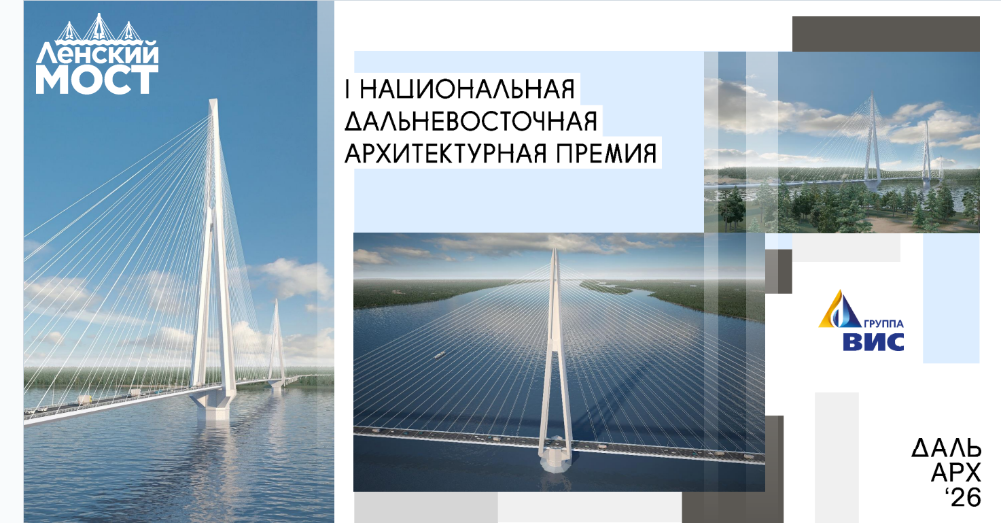
VIS Group has presented its project for a bridge crossing over the Lena River in the Republic of Sakha (Yakutia) as part of the second stage of DalArkh, the 1st National Far Eastern Architectural Awards. The project has been shortlisted in the “Best Infrastructure and Industrial Facility” category.
The award was established by the Ministry for the Development of the Russian Far East and the Arctic, the Far East and Arctic Development Corporation, and the Government of the Republic of Sakha (Yakutia). The project was evaluated by an expert jury comprising representatives from federal government bodies, leading architects, specialists in urban planning and regional development, as well as experts in infrastructure and the urban environment.
During the presentation, Sergey Kozlovsky, Head of the Corporate Communications Department at VIS Group, outlined the architectural and engineering solutions for the Lena Bridge, the specifics of its construction, and the project’s significance for enhancing transport accessibility and the socio-economic development of Yakutia.
Special attention was heeded to the technological solutions developed for construction in extreme climatic conditions. The materials selected for the project account for temperature fluctuations of up to 100°C (ranging from –60°C in winter to +40°C in summer), the presence of permafrost, seasonal floods, and powerful ice drifts. All of the bridge’s metal structures are designed to withstand these extreme conditions and are fabricated using cold-resistant steel grades. For the construction of the pylons within the riverbed, floating cofferdams are being employed for the first time in Russian bridge-building. The project also incorporates a comprehensive set of environmental protection measures, including the replenishment of the river’s aquatic biological resources and the restoration of forest resources. Over the past two years, nearly 13 million fry, including sturgeon, broad whitefish (chir), peled, and other species, have been released into the Lena River basin, and approximately 105,000 Siberian pine saplings have been planted.
“The Lena Bridge is not only a vital and highly complex infrastructure project, but also a magnificent piece of engineering. It will become a landmark for both Yakutia and the entire Russian Arctic, a symbol of the builders' fortitude and our nation's technological prowess,” noted Sergey Kozlovsky.
This unique infrastructure project will for the first time provide year-round road connectivity between the republic’s capital and the rest of the country. The bridge is being constructed under a concession agreement and is part of the “Infrastructure for Life” national project. VIS Group serves as both the investor and general contractor for the project; following its completion, the group will also manage the operation of this new transport artery through 2048.
Follow VIS Group:


