


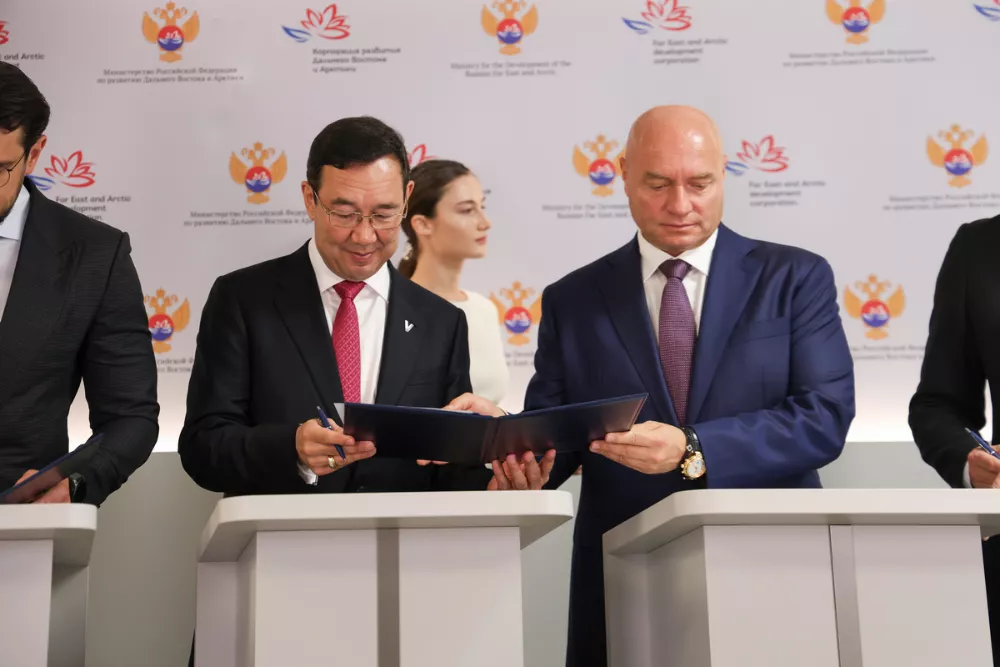
At the Eastern Economic Forum, VIS Group signed a multilateral cooperation agreement to implement the Mohe–Naiba International Transport Corridor (ITC) project. Other signatories included the Far East and Arctic Development Corporation, the Republic of Sakha (Yakutia), the Crystal Fund, the Development Corporation of the Republic of Sakha (Yakutia), OOO Taimyr Invest, and AO Railways of Yakutia. “The Mohe–Naiba International Transport Corridor is a project capable of fundamentally transforming the transport geography of Russia’s Northeast. The new corridor will link major Asia-Pacific markets with Yakutia, the Magadan Region, and the Trans-Arctic Transport Corridor. It entails the creation of over 2,900 km of new railway infrastructure, a deep-water port, and a new border crossing with China,” said Nikolay Zapryagaev, CEO of the Far East and Arctic Development Corporation (KRDV).
Preliminary estimates place the project's capital investment at 1.13 trillion rubles. Investment figures will be refined as design and survey work is completed and project documentation is approved.
“The Arctic is a strategic hub for Russia's economic growth and for us – a focal point for attracting investments that align with national project goals and our business strategy. VIS Group possesses the expertise required to execute this large-scale infrastructure project. We have built over 40 facilities of various types across the Russian Far North and Far East. I am confident that, working with our partners, we will successfully meet the objectives outlined in the signed agreement,” commented Sergey Yudin, CEO of VIS Group.
The Mohe–Naiba International Transport Corridor establishes a north-south link connecting Asia-Pacific and Southeast Asian nations to the Trans-Arctic Transport Corridor and includes the creation of a joint international border crossing with the PRC, the implementation of the first and subsequent stages of the Naiba deep-water port, a new railway line from Nizhny Bestyakh to Naiba spanning approximately 1,300 km, and a line to Magadan spanning about 1,670 km. The project's investment phase is tentatively scheduled to run until 2034.
“The volume of cargo capable of passing through the Mohe–Naiba corridor is estimated at 2 million tons per year. The established route will serve as the shortest path between China's northeastern provinces and the Arctic coast. This will help reduce the cost of delivered goods, accelerate economic development in the Arctic and Far East, and improve connectivity across this vast region,” noted Aisen Nikolaev, Head of Yakutia.
The agreement formalizes the parties' intention to coordinate their efforts in implementing the project, including assistance with conceptualization, site selection, infrastructure planning, securing state support and financing, and negotiating with potential investors and partners.
Follow VIS Group:


